Read in 2026
From short reads to epic ones and everything in between.
Some years ago, I realized I had only read one book over a calendar year. One. How hard would it be to read more? I am admittedly a slow reader. Basically, I read aloud in my head (apparently, this is the wrong way to read), assigning voices and parts to different characters. Yet, reading in bed anywhere from 15-30 minute intervals before falling to sleep, I can reliably read a typical-length book in a month. I decided that I would read at least one book a month. If I was stuck or struggling to enjoy the book, I would ditch it or switch to something more fun. As a lover of comics and graphic novels, it is easier to dive into something that only takes a couple of hours to read. This year, I finally decided to read, in its entirety, J.R.R. Tolkien’s The Silmarillion, a collection of his stories and tales that form the DNA and backbone of his Lord of the Rings epic. It was a slog. I often put it down and picked up something lighter only to doggedly return to try finishing it. In the end, I really appreciated how The Silmarillion was such a departure from the reality of the world’s conflicts, wars, politics, climate disasters, and many other ongoing crises. I read to inform and escape. Usually, my reading list is mostly non-fiction, but this year there was only one non-fiction book, and mostly I read graphic novels. I guess I felt the need to escape more than to be informed.
The Wood Chipper
Joe Ollman
A collection of Joe Ollman’s short comic stories that reflect on anxiety and grief.
Day Old
Joe Ollman
From Conundrum Press’ series of comic book short stories, this is about a guy working in a coffee shop who instead of throwing out the day-old bagels gives them to a mom having a terrible day. His kindness is a tiny moment of humanity in a sometimes inhuman world.
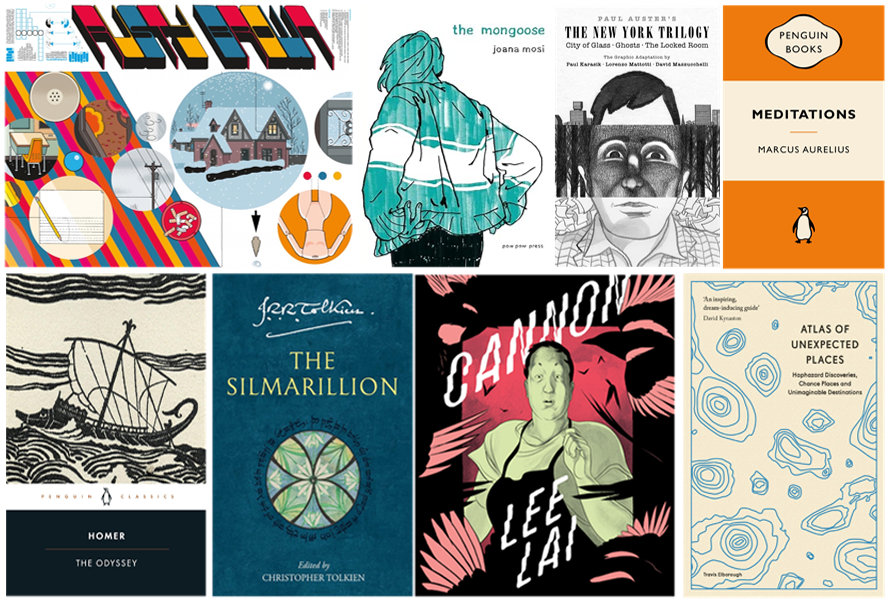
Cannon
Lee Lai
One friend is a taker, and the other is a taker of whatever the other one gives. This award-winning graphic novel is about Cannon, a young queer Asian woman working in an insanely stressful kitchen just as her grandfather is in need of care, and her best friend is not being the best of friends.
Pastimes
Pascal Girard
I love this little collection of daily journal entries from Quebec artist Pascal Girard, partly because it reminds me of my own comic journal, but Girard is far funnier.
Just Happy to See You
Shea Proulx
Another of Conundrum Press’s little short books. This is an odd and funny stream of consciousness from this B.C.-based artist.
Fever Dream
D. McFadzean
Another comic short about a couple caring for their sick kid and the worry it can create until that fever breaks.
Paul Auster’s The New York Trilogy
Adapted by Paul Karasik, Lorenzo Mattotti, David Mazzuchelli
OK. This is a graphic novel adaptation of American author Paul Auster’s short story collection, but it was not an easy or quick book to get through. It’s funny that it was talked about like a classic that the reader could return to again and again, but I have to admit, I wouldn’t recommend it, and I don’t quite even understand why the book was made?
The Silmarillion
J.R.R. Tolkien
Every year there’s one book that is too good to put down, but also too boring to continue. For all the LOTR fans out there, I’d argue that I really don’t have this much interest in the geography or genealogy of Middle-earth. I’ve actually read more interesting passages of the King James Bible. That being said, this is a collection of stories, so I easily could’ve just skipped ahead to a more thrilling section and not missed out on anything. I guess I’m a glutton for punishment.
The Mongoose
Joana Mosi
This book felt like it could have been a film. There aren’t many stories of grieving I would say that about, but its story structure and characters are really well shaped for such a short graphic novel.
Corto Maltese: Fable of Venice
Hugo Pratt
I did “read” this for its adventure in Venice, but really I was far more intrigued by Pratt’s drawing style. His use of fine line and blocky black shapes is something I’m always trying to balance in my own drawings, so what I was really reading was his lines and style.
Rusty Brown
Chris Ware
Hoo boy. No one fascinates me or bums me out more than Chris Ware. You know how many actors who portray villains will say, “No one thinks they are the bad guy.”? That’s the entry point for the actor into the villainous ego. In a sense, Chris Ware has built this world in this collection of comic book stories where we see inside the mind of the guy who is kind of a jerk, yet feels wronged somehow. His colour and line work are beyond compare, and his storytelling style is the only example of its kind. He’s kind of reimagined how you can tell a linear story in what some call “sequential art,” though it can’t be called either linear or sequential when it’s neither.
The Wasteland
T.S. Eliot
I’m not sure what brought me to read this dreary and depressing poem. In many ways, it seems to epitomize a period in England when people misunderstood pollution as fog and the kind of gloom that defined British life. Still, it’s full of striking imagery such as ‘singing grasses’ and the ‘testimonies of summer’.
The Love Song of J. Alfred Prufrock
T. S. Eliot
Obviously, if you have time for one poem, why not another? Plus, look at that title. My guess is that Eliot wasn’t a laugh riot, but could still make his friends chuckle when he wanted.
Atlas of Unexpected Places
Daniel Kynaston
This is a fun book of short descriptions of remarkable places like the island the size of a single summer house or a crevice in the desert that continually burns. The only drawback is that the poorly reproduced black and white images do not satisfy the curiosity triggered by the description. I found myself always doing web searches to see more images and then going down many a rabbit hole finding more. In short, it’s an interesting book, but if your goal is to get off your phone, it won’t help.
The Odyssey
Homer
Obviously, after seeing the movie, I wanted to reread the book. The copy I have is a 1946 translation, and I love the strangely stilted formality of the writing. It’s from this book I first read phrases, like “the wine-dark sea” or the “goddess with the flashing eyes”. To me, it is so evocative of another time, a different way of thinking and seeing the world. There was certainly a lot I forgot, such as what an arrogant braggart Odysseus could be. No wonder Poseidon wanted to drown him.
Meditations
Marcus Aurelius
Probably history’s first self-help book, written sometime between 161-180 CE, this is Aurelius’ collection of personal notes and reflections meant for himself and to clarify his thinking on Stoic philosophy. I’m not sure of the translation of the version I read, but it certainly feels modern in its contemplation of the self.
posted by Rowdyman at 11:54 AM



0 Comments:
Post a Comment
<< Home